

Sade Sati is counted from the Moon sign, not the Sun sign. It is the stretch of time in which Shani (Saturn), moving through the sidereal zodiac, crosses the sign before your Janma Rashi, the Janma Rashi itself, and the sign after it. Saturn spends roughly two and a half years in each sign, so the three passages add up to about seven and a half years — the “sade sati” of the name. For Kumbha, those three signs are Makara (Capricorn), Kumbha (Aquarius) and Meena (Pisces).
Kumbh Rashi Sade Sati Start and End Dates
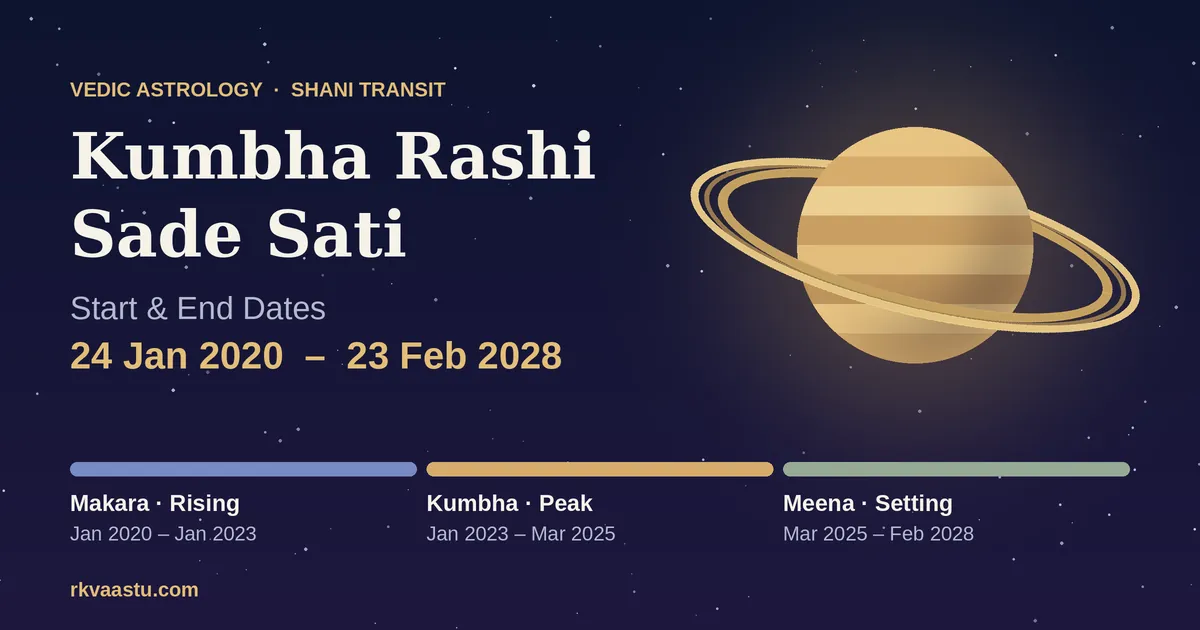
- Start: 24 January 2020, when Saturn entered Makara, the 12th sign from Kumbha.
- First phase (rising): 24 January 2020 to 17 January 2023, interrupted from 29 April to 12 July 2022 while Saturn made a brief first pass into Kumbha.
- Second phase (peak): 29 April to 12 July 2022, then 17 January 2023 to 29 March 2025, with Saturn transiting Kumbha itself.
- Third phase (setting): 29 March 2025 to 3 June 2027, then 20 October 2027 to 23 February 2028, with Saturn in Meena, the 2nd sign from Kumbha.
- End: 23 February 2028, when Saturn moves into Mesha (Aries) for the last time in this cycle.
Through the rest of 2026 and into 2027, Kumbha natives are in the third and final phase.
Why the 2027 Dates Look Confusing
Saturn does not move steadily forward. Each year it turns retrograde for four to five months, and when that happens close to a sign boundary it can cross the same boundary three times. That is exactly what happens at the end of this Sade Sati. Saturn enters Mesha on 3 June 2027, slips back into Meena on 20 October 2027, and moves into Mesha a final time on 23 February 2028.
Most almanacs therefore show June to October 2027 as a gap, when Kumbha is technically outside Sade Sati, and give 23 February 2028 as the final end date. Some practitioners read the whole stretch up to February 2028 as one continuous setting phase, on the view that a transit which returns has not finished its work. Both readings agree on the final date. The same back-and-forth happened at the start of the peak phase in 2022.
Why some sources say 24 February 2028
A Saturn ingress is calculated to the minute. When that moment falls near midnight, the calendar date depends on which time zone the almanac is computed for, and on the ayanamsa — the correction used to convert the tropical zodiac into the sidereal one that Jyotish uses. A one-day difference between two reputable panchangs is expected, not an error. The dates in this article follow the Lahiri ayanamsa, the standard in most Indian almanacs, at Indian Standard Time.
Aquarius Sun Sign Is Not the Same as Kumbha Rashi
Many searches for “Aquarius Sade Sati” come from people born between late January and mid-February, whose Western sun sign is Aquarius. Western astrology uses the tropical zodiac and the Sun. Sade Sati uses the sidereal zodiac and the Moon. The two rarely coincide.
The Moon changes sign roughly every two and a quarter days, so a person born in any month of the year can be Kumbha rashi — and most people who call themselves Aquarius are not. If the Moon was near the edge of a sign at birth, a difference of an hour or two in the recorded birth time can move it into the neighbouring sign. Some families also use a name rashi taken from the first syllable of a person’s name. Sade Sati is traditionally read from the Janma Rashi, the Moon’s actual position at birth, which is why an accurate birth time matters more than the sign you have always assumed.
What Each Phase Is Traditionally Associated With
Classical texts link each phase to the house Saturn occupies, counted from the Moon.
- Rising phase (Saturn 12th from the Moon): traditionally associated with expenditure, travel, time spent away from home, and sleep.
- Peak phase (Saturn over the Moon): associated with the mind, personal responsibilities and self-image — the phase in which Saturn’s themes are considered most personal.
- Setting phase (Saturn 2nd from the Moon): associated with family, speech, and accumulated resources.
These are themes, not forecasts. Whether any of them becomes noticeable in a particular life depends on the rest of the chart: Saturn’s own placement at birth, the Mahadasha and Antardasha running during the transit, and the Ashtakavarga score — the number of bindus, from zero to eight — that Saturn holds in each sign it crosses. A sign with five or more Saturn bindus is traditionally regarded as an easier passage than one with two.
There is one point specific to Kumbha. Saturn is the ruling planet of Kumbha, and Kumbha is Saturn’s mooltrikona sign. Many practitioners hold that Sade Sati is gentler for the two Saturn-ruled signs, Makara and Kumbha, than for signs whose lords are hostile to Saturn. It is a traditional view rather than a rule, and the chart as a whole still decides.
After February 2028
Once Saturn settles in Mesha, it sits 3rd from Kumbha — a transit position that Jyotish traditionally regards as one of Saturn’s more favourable. The next Saturn transit that Kumbha natives usually ask about is its entry into Vrishabha (Taurus), the 4th sign from Kumbha, first in August 2029. That period is called Kantak Shani or dhaiya. The next full Sade Sati for Kumbha begins when Saturn returns to Makara, roughly three decades after 2020.
Practices Traditionally Associated with Saturn
Saturday observances, recitation of the Shani stotra or the Hanuman Chalisa, and giving black sesame, mustard oil or dark cloth in charity are the practices most commonly associated with Saturn in the tradition. Service to elderly people and to those who do physical labour is regarded in the texts as closest to Saturn’s nature. These are intended to support a steadier approach to the period; they carry no promise of any particular result.
One caution. Neelam (blue sapphire) is widely suggested online for Sade Sati. It is among the most chart-specific stones in Jyotish, and I do not recommend wearing it on the basis of a Moon sign alone.
In Vastu Shastra, the west is the direction associated with Saturn. Keeping the western zone of a home or office orderly and uncluttered is a simple, low-cost practice some people prefer during this transit. The role of each direction in Vastu is covered in more detail separately.
Check the Chart Before Relying on the Dates
The dates above are the same for every Kumbha native. How the period reads for you is not. A chart review confirms your Janma Rashi from your birth details, identifies the dasha running alongside the transit, and looks at Saturn’s strength in Meena and Mesha for the remaining months.
Consultations are conducted online with RK Babbar, who has 25+ years of practice in Vastu and Vedic astrology and holds the Jyotish Ratna and Jyotish Bhushan qualifications from AIFAS. Sessions start from AED 100 for one hour; if you are in the UAE, the online astrology consultation page sets out how sessions work. To arrange a session, message RK Vaastu on WhatsApp. If you choose to share your birth date, time and place, they are used only to prepare your chart; our privacy policy explains how they are handled.
More articles on Jyotish are in the astrology section, and you can read about RK Babbar’s practice.
Astrology and Vaastu are belief-based practices and are provided for guidance purposes only. Results may vary from person to person and should not replace professional, legal, or medical advice.